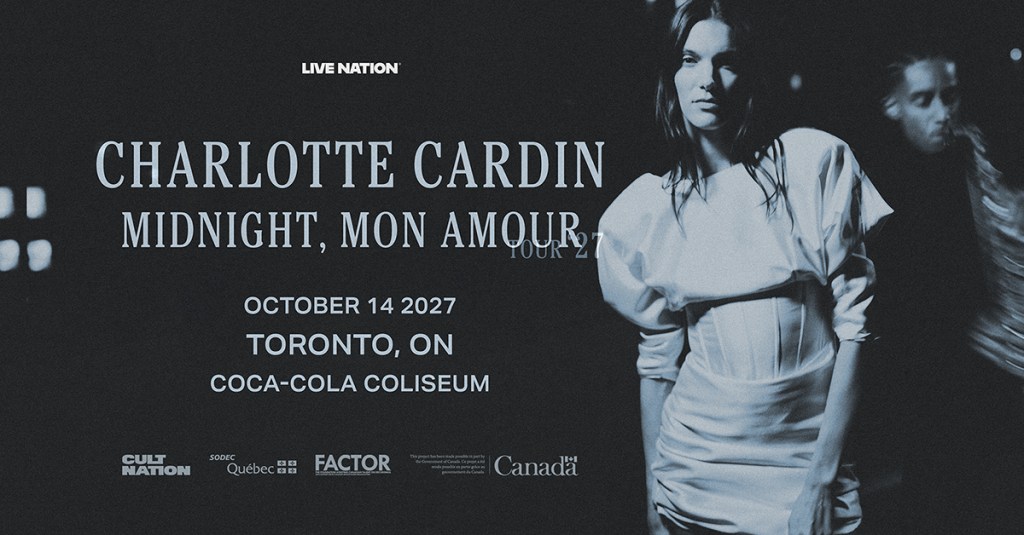
Charlotte Cardin is coming to Coca-Cola Coliseum on Thursday, October 14th, 2027!
Live Nation Presale: Wednesday, October 28th, 2026 @ 10am (sign up via All Access)
All Presales End: Wednesday, October 28th, 2026 @ 10pm
Public On Sale: Thursday, October 29th, 2026 @ 10AM
CLICK HERE to get your tickets!
Charlotte Cardin has never been defined by just one lane, a theme she’s taking to the next level with her upcoming third album, Midnight, mon amour, due out January 29, 2027. Since cementing herself as one of Canada’s most exciting and formidable artists, the Montreal-born singer has built a career out of moving fluidly between pop, R&B, jazz, and anything else that catches her ear, splitting her time between Canada and Paris as she continues to expand the boundaries of her sound.
Her 2021 debut album, Phoenix, established her as an immediate sensation, earning her Album of the Year, Pop Album of the Year, Artist of the Year and Single of the Year at the Juno Awards. Her success continued with her sophomore release, 99 Nights, which earned Album of the Year and Pop Album of the Year once again.
Now, Cardin is returning with her most ambitious album yet. With Midnight, mon amour, Cardin digs into duality, exploring the tension between societal expectations and the parts of ourselves we keep hidden, the contrast between day and night, and the ever-present contradictions of existing as a woman. “I really wanted to explore all of the inner duality that I’ve been feeling as a woman in the last few years, and I wanted to use those oppositions and those contradictory feelings as something that’s empowering and liberating,” she explains. “It’s about giving myself permission to explore dualities, and hopefully helping others feel they can, too.”
Cardin and her longtime collaborator Jason Brando approached the album with that tension in mind. The result is what Cardin describes as a “shadow album:” a space for the shameful fantasies, private desires and less-polished parts of ourselves that we don’t necessarily reveal to the outside world. “That musical playground of duality, and knowing that we are allowed to explore those two things, really opened up a whole new level of creativity for me,” she says.
Throughout the deeply nocturnal LP, Cardin is interested in what happens after dark, when the boundaries we maintain during the day begin to soften. “At nighttime, certain parts of us — whether it’s because we’re asleep and dreaming and letting our imagination make up all of these stories, or whether we’re allowing our fantasies to blossom a little bit — come out,” she says. She’s fascinated by the parts of humanity that we feel most inclined to hide under the sun, and that same push and pull extends to the album’s use of language, with Cardin moving between French and English as another way of inhabiting different sides of herself.
Cardin kicked off her latest chapter with the release of “The Way We Touch,” leaning into glamour and intrigue over an inviting beat as she sings, “Maybe I’m idealizing the last time we met / It was holy / Now everything’s up in the air.”
She followed it with “Take Me Back,” a more subdued and atmospheric track built around moody saxophone and a sense of desperation, accompanied by a lush short film directed by Oscar-nominated filmmaker Vincent René-Lortie.
“Memories,” due out October 9, shifts the energy again. An upbeat earworm with the feeling of a night out just beginning to take off, the song examines the way emotion can alter our relationship with the past. “‘Memories’ is about the thoughts that are on loop for so long that they end up shifting,” Cardin says. “The more you think of something — especially when you’re very implicated emotionally — the more your memories will shift, and your own emotions tint the memory.” The result is a song that Cardin included on the final record in both English and French about a moment that becomes increasingly difficult to distinguish from the version of it that exists in your head.
That idea connects to one of the album’s larger themes: the lives we imagine but never live. Throughout the project, Cardin embraces vulnerability and fantasy in equal measure, imagining alternate paths, people, and plotlines to see where the results may lead. The album is marked by three distinct versions of one track, titled “Fleur,” allowing the story to unfold as an exploration of those alternate possibilities and what-ifs, rather than an attempt to resolve them. Embracing the fantastical lends a dreamy, fairytale sheen to Midnight, mon amour.
“I chose one door, but all of these other doors still exist, and sometimes I think about them,” she says. “That’s going back to that duality of being so happy in a relationship and embracing that, but also being allowed to mourn the what-ifs and the lives that you didn’t choose.” It’s a sentiment that she returns to throughout the album — not a rejection of the life she chose, but an acknowledgment that accepting one path doesn’t erase curiosity about the others.
Even as Cardin dug deeper into the album’s more private and contradictory spaces, she was mindful of how those songs would exist outside the studio. She and her collaborators paid particular attention to the brass throughout the record and how its arrangements could translate to the stage, building a set that can expand or contract depending on the size of the room. “The live performance part of things is one of the most exciting parts of what I do,” she says. “I love writing music, but I also love thinking about how it’s going to convert to a live context.”
That instinct reflects Cardin’s broader approach to her work. Music is only one part of the vocabulary she draws from, with cinema, literature, fashion, and a modeling background all informing the way she thinks about storytelling. Her references are similarly wide-ranging: She cites Canadian pop icons such as Celine Dion and Avril Lavigne alongside Ella Fitzgerald and the songwriting of Kacey Musgraves. She’s especially drawn to artists with unmistakable voices given the husky, instantly recognizable quality of her own.
Although Midnight, mon amour was developed across Canada, London and Paris, Cardin says home remains the place where her creativity comes most naturally. “There’s something very creative that comes out of me when I’m in Montreal,” she says. “I have so many references and
so many memories in Montreal.”
Those accumulated memories, influences, and contradictions all find their way into the new album, which ultimately asks what happens when we stop trying to choose between the different versions of ourselves and instead give all of them room to exist.
 Ad Choices
